What Are AI Powered Security Systems? Why Are Businesses Adopting This Technology in 2026?
AI powered security systems do not transform cameras into “all knowing” devices; instead, they create a decision support layer that classifies visual and event data and directs the operator’s attention to the right moment.
In corporate security operations, the main problem is often not a lack of data, but the inability to evaluate excessive amounts of data in a timely manner. Continuously monitoring hundreds of cameras, comparing thousands of access records, and selecting a critical alarm from among similar notifications push the natural limits of human attention. At this point, artificial intelligence can accelerate repetitive classification and search tasks and present the security team with a narrower set of events that require review.
However, the purchasing decision should not be based solely on the “AI enabled” label. The use case solved by the analytics, the visual conditions under which it operates, the false alarm rate, the required licence and processing capacity, the impact on personal data, and its integration with the existing VMS should all be evaluated together. A successful project depends not only on model accuracy but also on the operational process that follows the alarm.
Decision Support Layer in Intelligent Security
What Is an AI Powered Security System?
An AI powered security system is a combination of software and hardware that extracts meaningful features from video, audio, access, sensor, or device-health data and uses them for search, classification, anomaly detection, or alarm prioritisation.
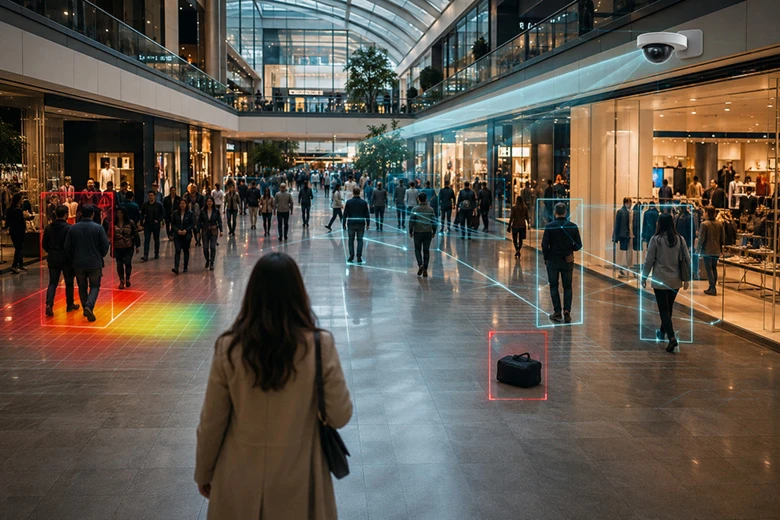
On the video side, metadata such as people, vehicles, objects, direction of movement, zones, duration, and similar information can be generated. When this metadata is associated with the recording, it becomes possible to locate specific events more quickly.
The system does not have to make decisions completely automatically. The most common and safest use is for the analytics to flag a potential event, for the VMS or event management platform to present the relevant footage and procedure to the operator, and for an authorised person to make the verification and response decision.
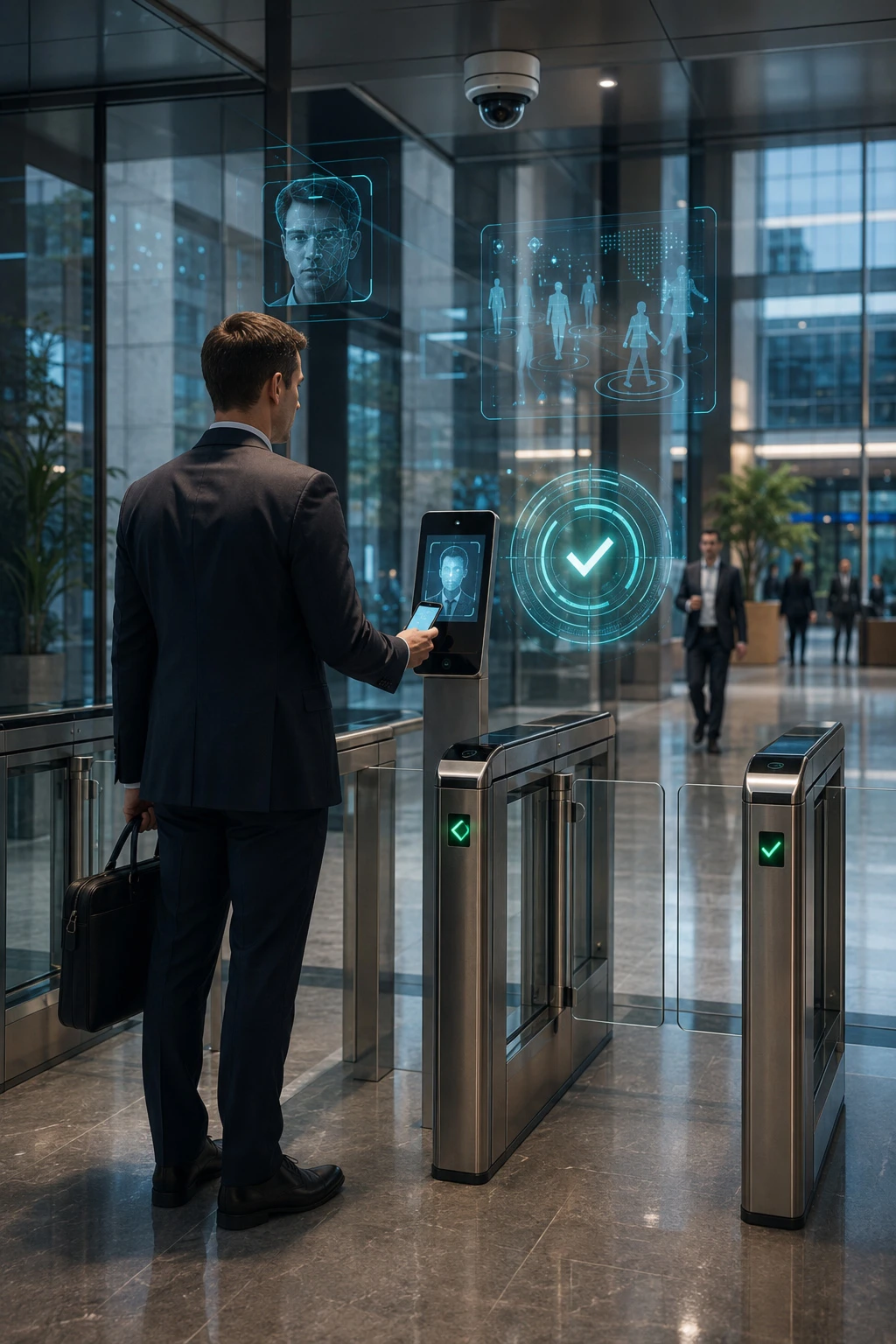
In critical scenarios, human oversight is a fundamental design element for limiting the impact of errors and evaluating the context of an event.
Video Analytics
Events such as people, vehicles, objects, direction of movement, zone violations, and dwell time are classified.
Intelligent Event Search
Long video recordings are quickly narrowed down according to time, location, object, and event characteristics.
Alarm Prioritisation
Events that are more important for security operations are highlighted among similar notifications.
Human Verification
The analytics flags the event, while contextual evaluation and the response decision are made by an authorised person.
Realistic expectation: Artificial intelligence cannot know with certainty that a threat will occur before it happens. It can flag defined patterns and unusual situations; alarm accuracy depends on site conditions, data quality, threshold settings, and human verification.
Transforming Images into Searchable Data
How Is It Different from Traditional Video Surveillance?
Live Monitoring and Recording
A traditional system provides live viewing, recording, playback, and manual post-event review functions.
Metadata Generation
Characteristics such as people, vehicles, direction, zone, duration, and objects are associated with the video recording.
Targeted Search
The operator can filter recordings according to specific time, location, object, or behaviour criteria.
Object Classification
Object classes such as people and vehicles can be distinguished, allowing more meaningful alarms to be generated than with basic motion detection.
Faster Investigation
Reviewing recordings that could otherwise take hours can be reduced to a narrower set of events using analytics results.
Site-Specific Rules
Threshold, zone, direction, and time rules should be configured separately for each camera and use case.
Important distinction: Object classification can help reduce unnecessary notifications, but promising to eliminate false alarms completely is not realistic.
Applications for Security and Operations
Main Use Cases
The value of AI analytics does not come from a general definition of a “smart camera,” but from measurable and verifiable use cases. For each scenario, the detection objective, operating conditions, acceptable error rate, and the procedure to be followed after an alarm should be defined separately.
Perimeter and Zone Security
The system monitors whether a person or vehicle approaches a defined line, enters a zone, remains there for a certain period, or moves in the wrong direction.
Forensic Video Search
Long recordings are narrowed down according to time, location, person or vehicle characteristics, and event type.
Licence Plate Recognition
Support is provided for entry and exit records, access lists, car parks, and logistics flows; angle, speed, and lighting conditions are tested on site.
Occupational Health and Safety
Alert support can be provided for situations such as missing helmets or safety vests, hazardous zones, falls, or violations of workplace rules.
Crowd and Queue Analysis
People counts, waiting times, and area occupancy are transformed into operational indicators.
Facility and Process Monitoring
Situations such as doors being left open, objects being left behind or removed, and loading-area flows can be monitored.
Thermal Analytics
With compatible hardware, temperature differences, smoke, or early-warning scenarios can be evaluated.
Access Control Integration
Camera footage, card-access records, door status, and authorisation information can be associated within the same event context.
Device Health Monitoring
Technical conditions such as video loss, connection problems, focus deterioration, and system availability can be monitored.
Distributed and Scalable Processing Architecture
Where Does Artificial Intelligence Run?
Camera or Edge Device
When analytics runs on the camera or an edge device at the site, events and metadata can be generated without transmitting the entire video stream to a central location.
This structure can reduce latency and bandwidth requirements and may allow certain functions to continue locally when the connection is interrupted.
Local Server or Data Centre
A central server can run analytics for multiple cameras using a shared resource pool.
It can provide advantages such as preserving the existing camera investment, using more powerful models, and keeping data within the organisation.
Cloud and Hybrid Architecture
Cloud-based analytics can provide multi-site management, centralised updates, and easier scalability.
Data residency, internet dependency, storage, cost, security, and contractual conditions should be evaluated together.
Operational Efficiency and Visibility
Tangible Benefits for Businesses
When designed correctly, artificial intelligence enables the security team to work more effectively within the same volume of data. The benefit is not based on the assumption of reducing staff, but on directing attention and time towards more valuable tasks.
- Transforming the live-monitoring workload into an event and priority based workflow
- Reducing event investigation time through targeted searches within recordings
- Creating common alarm categories and reporting across multiple locations
- Associating data from cameras, access control systems, perimeter sensors, and business systems
- Generating measurable data for device health, alarm density, and operational performance
- Improving site design and procedures by using recurring event patterns

Correct Interpretation of Analytics Performance
Limitations: False Positives, False Negatives, and Model Drift
Analytics performance cannot be explained using a single accuracy percentage. A false positive flags a non existent event as an alarm and increases the operators workload. A false negative misses a real event and can create a critical security vulnerability.
As seasons, lighting conditions, camera angles, scene layouts, and human behaviour change, the performance of a model that was initially successful may decline. This situation should be monitored as model drift or data drift.
False Positive
Flagging a situation that does not actually exist or is not relevant as an alarm increases the operator’s workload.
False Negative
Failing to detect a real event creates a significant risk, particularly in critical security scenarios.
Model Drift
As seasons, lighting conditions, camera angles, and scene layouts change, model performance may decline over time.
Acceptance testing recommendation: Do not use only demonstration footage. Measure false positive and missed event rates separately using labelled real site examples recorded during daytime, at night, in rain, in crowded conditions, at different speeds, and from different viewing angles.
Lawful and Proportionate Data Processing
Personal Data Protection, Privacy, and Biometric Data
Camera footage and the metadata generated from it may constitute personal data when associated with an identified or identifiable individual. The project should be designed around a specific purpose, an appropriate legal basis, necessity, proportionality, transparency obligations, access authorisation, retention, and destruction rules.
Facial recognition and other biometric methods represent a higher risk area. Whether alternative methods are sufficient, whether the application is necessary and proportionate, and whether the provisions governing special category personal data apply should be evaluated separately.
Purpose Limitation
Footage and metadata should be processed only for clearly defined and legitimate purposes established in advance.
Necessity and Proportionality
The method used should be appropriate for the intended security requirement and limited to the scope that is necessary.
Access Authorisation
Permissions for live footage, recordings, metadata, searches, and exports should be restricted according to job responsibilities.
Retention and Destruction
How long data will be retained, how it will be deleted, and how exceptions will be managed should be defined.
Biometric Data
For methods such as facial recognition, necessity, proportionality, and alternative methods should be evaluated separately.
Human Oversight
Critical decisions should not be left solely to automated matching; verification and objection mechanisms should be defined.
A Fundamental Requirement for Network Connected Systems
There Is No Intelligent Security Without Cybersecurity
A network-connected camera and analytics server are also IT assets that must be managed. The device identity, software version, support period, and network location should be visible in the asset inventory.
Asset Inventory
Device identity, model, version, network location, support period, and system owner should be recorded.
Identity and Authorisation Management
Default passwords should be removed, the principle of least privilege should be applied, and multi-factor authentication should be used whenever possible.
Network Segmentation
Camera and security systems should be separated from the corporate network using the necessary traffic rules.
Secure Remote Access
Maintenance and management connections should be carried out through secure channels, authorised accounts, and audit logs.
Update Management
The source, verification, testing method, and rollback plan for software, model, and device updates should be defined.
Supply Chain Security
Third-party components, data-transfer points, vulnerability notifications, and patching periods should be clearly specified in the contract.
Why Is It Receiving More Attention in 2026?
The increased interest in 2026 is not driven by a single technological leap. The processing capacity of edge devices is increasing, the metadata generated by cameras is becoming richer, and VMS platforms are establishing more open integrations with events beyond video.
Organisations managing multiple locations are seeking centralised policies, common alarm categories, and remote visibility into system health. These developments enable a broader group of businesses to evaluate analytics scenarios that were previously seen only in large-scale projects.
At the same time, expectations are also maturing. Organisations are asking not only “Did it detect the event?” but also about the false-alarm rate, its impact on operational time, data responsibility, and lifecycle cost.
The correct approach is not to present the technology as a necessity, but to deploy it in a controlled manner when there is a measurable use case.
Step by Step Selection and Verification Process
How Should the Right Solution Be Selected?
Define the Problem and Success Criteria
Instead of using a broad objective such as “a smarter camera,” use a measurable goal such as “reducing the false-positive rate for perimeter alarms at night.”
Verify the Existing Infrastructure
Prepare an inventory of camera-image quality, viewing angles, VMS version, network, storage, servers, and licences.
Determine Data Requirements
Define which data is processed, where it is stored, who can access it, and how long it will be retained.
Compare Architectural Options
Evaluate the latency, cost, security, and operational impact of edge, local-server, cloud, and hybrid models.
Test the Integration
Verify that the alarm works with the expected context throughout the VMS, access-control, mapping, notification, and event-management workflow.
Conduct an On-Site Pilot
Carry out a test plan that covers different conditions and a sufficient number of positive and negative examples in real scenes.
Document the Acceptance Thresholds
Set targets for false positives, false negatives, alarm latency, system availability, and operator processing time.
Plan the Lifecycle
Include responsibilities for model, software, and device updates, performance monitoring, retesting, maintenance, and support in the contract.
Measurable Performance Management
Which KPIs Can Be Used to Monitor Performance?
- False positive and missed event rates per verified event
- Time elapsed between alarm generation and operator verification
- Average time spent searching for an event and the rate of relevant recordings found
- Availability of analytics channels, cameras, and servers
- Alarm density per camera and the reason for closure by the operator
- Rate of critical scenarios revalidated after an update
- Exceptions related to user permissions, exports, and audit logs
Approaches That Reduce Project Success
Common Mistakes
Selecting a Solution Based on the “AI Enabled” Label
A selection made without determining which use case the analytics solves may not produce measurable results.
Considering Demonstration Footage Sufficient
Analytics that works in a controlled environment may not produce the same result under real-site lighting, weather, and camera-angle conditions.
Neglecting Image Quality
Insufficient resolution, an unsuitable lens, a poor viewing angle, and a low frame rate directly affect analytics performance.
Leaving Integration Until Later
Failure of an analytics alarm to work with the VMS, mapping system, access control, and operator procedures creates a disconnected workflow.
Removing Human Oversight
Accepting an automated result as the sole decision in critical security and biometric scenarios increases risk.
Failing to Retest Performance
It should not be assumed that analytics performance will remain unchanged after seasonal, scene, or software changes.
When Should Analytics Performance Be Reassessed?
Analytics rules and models should be reassessed according to a defined periodic review schedule. In high-risk security scenarios, sampling and testing intervals may be shorter.
Changes to camera angles, the installation of new lighting, environmental modifications, seasonal changes, VMS or camera updates, model-version changes, and security incidents should trigger an interim assessment.
An increase in false alarm density, the detection of missed events, or operator feedback also requires thresholds and scene definitions to be reviewed again.
Measurable and Manageable Security Architecture
Why iTech Project?
iTech Project does not treat artificial intelligence analytics solely as a product feature; it evaluates the technology together with cameras, the VMS, network, servers, alarm procedures, and data governance.
It identifies where the existing infrastructure can be preserved, designs the architecture appropriate for the use case, and verifies critical performance through a real-site pilot.
The objective is not to install a solution that appears impressive during a demonstration, but to establish a measurable and manageable solution for daily operations.
Free ConsultationTurn Your Project into a Concrete Plan
Transform Your Security Data into Measurable Operational Value
Contact iTech Project to add artificial intelligence analytics to your existing CCTV infrastructure, establish a new security architecture, or manage multiple locations through a common platform.
Frequently Asked Questions
Some server based or cloud-based analytics can use existing video streams. However, suitable image quality, camera angles, codecs, protocols, processing capacity, and licences are required. Critical features should be verified through on-site testing.
The main objective is not to eliminate security personnel, but to reduce repetitive monitoring and search workloads and direct attention towards events that require verification. Responsibility for critical decisions and interventions remains with people.
No. Analytics can run on the camera, on a local server, in the cloud, or within a hybrid architecture. The appropriate model is selected according to data policies, latency, network capacity, cost, and business continuity requirements.
No. For applications that process biometric data, the legal basis, necessity, proportionality, alternative methods, and provisions governing special category personal data should be evaluated separately.
Correct-detection, false positive, and missed-event rates are calculated separately using labelled real site examples. Tests should cover different times of day, weather conditions, crowd densities, camera angles, and update scenarios.