Transforming Existing CCTV Infrastructure with Artificial Intelligence
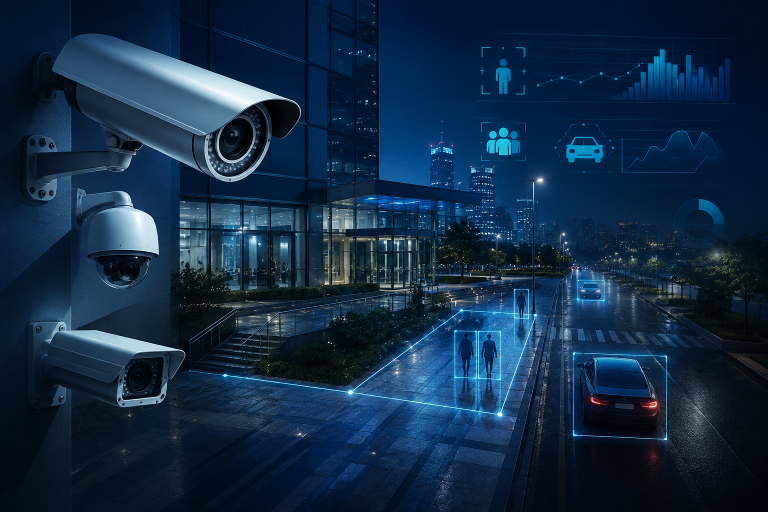
The rapid evolution of security technologies is significantly changing the role of CCTV systems. For many years, traditional camera systems were primarily used for video monitoring and recording. Today, AI-powered video analytics are transforming CCTV infrastructure into intelligent systems capable of interpreting events, detecting predefined situations and generating meaningful data for security and operational teams.
This transformation does not always require replacing the entire existing camera infrastructure. With the right technical assessment, existing IP cameras, network infrastructure and video management systems can often be retained while an additional artificial intelligence analytics layer is introduced.
The key approach is to evaluate the existing CCTV environment, identify which components can continue to be used and determine where modernization is actually required.
CCTV Systems Are No Longer Just Recording Video
In traditional security systems, the primary function of cameras is to transmit video to a recording device or Video Management System (VMS). When an incident occurs, operators either monitor the video in real time or review recorded footage afterwards.
AI-powered video analytics add an intelligent layer to this process.
Camera streams can be analyzed in real time, allowing people, vehicles and specific objects within the scene to be classified. Based on predefined rules and scenarios, the system can automatically generate events or alarms.
Instead of requiring operators to continuously monitor hundreds of camera feeds, AI analytics can help direct their attention to events that require further investigation.
As a result, CCTV infrastructure can evolve from a passive recording system into an active security and operational platform.
Why Preserving Existing CCTV Infrastructure Matters
Corporate CCTV investments consist of much more than cameras alone.
Existing infrastructure often includes:
- IP cameras,
- Network switches,
- Fiber and copper communication infrastructure,
- NVR systems,
- Video Management Systems,
- Servers,
- Storage systems,
- Security operation centers.
For this reason, approaching AI transformation by replacing the entire system can create unnecessary investment costs.
A more efficient strategy is to assess the technical capabilities of the existing infrastructure and retain the components that are still suitable for the intended application.
For example, if existing IP cameras provide sufficient image quality and suitable viewing angles for the required analytics, replacing the cameras may not be necessary. Instead, their video streams can be processed by a centralized AI analytics server.
This approach can significantly optimize investment costs, particularly in large facilities with extensive camera networks.
How AI Video Analytics Can Be Integrated into Existing CCTV Systems
Artificial intelligence video analytics can be integrated into existing CCTV environments using several different system architectures.
Edge AI Architecture
In an Edge AI architecture, video analysis is performed directly on the camera or on a nearby processing device.
Instead of sending the entire video stream to a central server for analysis, processing can take place locally, while only events, alarms or metadata are transmitted to the central system.
Edge architectures can be particularly beneficial in applications where low latency is important or network bandwidth is limited.
Centralized AI Server
Processing video streams from existing cameras on a centralized AI server is one of the most common approaches for large CCTV systems.
In this architecture, existing cameras continue to generate video while the AI server analyzes their streams.
Different analytics models can operate simultaneously, and detected events can be forwarded to the organization's security management platform.
This architecture provides an effective modernization option for organizations that want to introduce AI capabilities without replacing their existing camera infrastructure.
VMS Integration
Video Management Systems are at the center of many modern CCTV environments.
Integrating AI analytics with the VMS allows detected events to be delivered directly to operator screens.
For example, if a person enters a restricted area, the analytics platform can generate an event and automatically display the relevant camera feed to the operator.
This type of integration prevents artificial intelligence from becoming an isolated analytics system and instead makes it an active part of daily security operations.
AI Analytics Use Cases for Existing CCTV Infrastructure
The potential applications of AI-powered video analytics extend beyond traditional security monitoring.
With appropriate camera positioning and the right system architecture, existing CCTV infrastructure can also support a wide range of operational use cases.
Perimeter Security
AI video analytics can automatically detect people or vehicles entering predefined areas around factories, energy facilities, logistics centers or critical infrastructure sites.
Unlike traditional motion detection, AI analytics can classify objects within the scene and help reduce unnecessary alarms caused by environmental movement.
Person and Vehicle Classification
Classifying detected objects as people or vehicles allows more precise security scenarios to be created.
For example, vehicle movement may be ignored in a specific area while an alarm is generated when a person enters the same restricted zone.
Virtual Line Crossing and Zone Analytics
Virtual lines and defined zones can be created within camera images to analyze movement direction and area access.
These technologies can be used around facility entrances, warehouse areas, logistics yards, production environments and restricted zones.
Occupancy and Density Analytics
The number of people within a defined area and changes in occupancy levels can be analyzed to provide real-time operational information.
This approach can be used in retail stores, waiting areas, commercial facilities and other environments where occupancy and visitor flow are important.
Operational Video Analytics
Data generated by camera systems can be used not only for security but also to measure operational performance.
Movement density, visitor flow and time spent in specific areas can be analyzed to produce measurable insights into operational processes.
At this point, CCTV infrastructure begins to function not only as a security system but also as an additional source of business intelligence.
Not Every Camera Is Suitable for AI Video Analytics
The ability to integrate artificial intelligence into an existing CCTV system does not mean that every camera is automatically suitable for every analytics scenario.
Image quality is one of the most important factors affecting analytics performance.
In addition to camera resolution, several factors can directly influence detection accuracy:
- Camera installation height,
- Viewing angle,
- Lens selection,
- Low-light and night performance,
- Lighting conditions within the scene,
- Object size within the image,
- Video compression levels.
For this reason, evaluating camera specifications alone is not sufficient. Real video footage and the intended use case should be assessed together.
Network and Server Capacity Must Be Properly Planned
In centralized AI video analytics architectures, camera streams must be transmitted over the network to the analytics server.
In projects involving dozens or hundreds of cameras, this can have a direct impact on both network traffic and server resources.
System planning should therefore consider:
- Camera resolution,
- Frames per second (FPS),
- Bitrate,
- Video codec,
- Number of cameras analyzed simultaneously,
- Number and complexity of AI models being processed.
GPU requirements should not be calculated based only on the number of cameras. Running multiple analytics models on the same video stream can significantly change the processing requirements.
Integration Is as Important as the Analytics Itself
Detecting a person, vehicle or event with artificial intelligence does not by itself create an effective security solution.
What happens after an event is detected is one of the most important parts of the overall system design.
Events generated by the analytics platform can be:
- Displayed within the VMS,
- Presented directly to security operators,
- Forwarded to an alarm management platform,
- Used to generate mobile notifications,
- Integrated with other security systems,
- Transferred to reporting and analytics platforms.
This approach transforms AI analytics from a standalone detection technology into an active component of security and operational workflows.
Measuring Real-World Performance Through Pilot Projects
Real-world environmental conditions play a critical role in the performance of AI video analytics.
An analytics model may perform very well in laboratory environments or manufacturer demonstrations while producing different results when deployed at an actual site.
Lighting changes, rain, shadows, vehicle headlights, high pedestrian traffic and camera angles can all affect analytics performance.
For this reason, large-scale deployments should ideally begin with a controlled pilot project using a limited number of cameras.
During the pilot phase, actual operational scenarios can be tested and several key performance indicators can be measured:
- Detection accuracy,
- False alarm rates,
- System latency,
- Operator experience,
- Network utilization,
- Server and GPU capacity.
Based on the results, the system architecture can be optimized before expanding the solution across a larger CCTV environment.
Turning Existing CCTV Investments into Data-Driven Infrastructure
The success of modern CCTV projects is no longer measured only by the number of cameras installed or their resolution.
The real value comes from how effectively video can be transformed into meaningful and actionable information.
With AI-powered video analytics, existing camera infrastructure can become a system that:
- Automatically detects defined events,
- Directs operators toward relevant incidents,
- Supports security risk monitoring,
- Analyzes operational activity,
- Generates measurable and reportable data.
This transformation can be particularly valuable for organizations that already operate large-scale CCTV infrastructure and want to generate greater value from their existing technology investments.
The Right Starting Point Is an Assessment of the Existing System
Before selecting new cameras, servers or analytics software, the first step in an AI video analytics project should be a detailed assessment of the existing infrastructure.
By evaluating the camera environment, network architecture, VMS, storage systems and operational processes together, organizations can clearly identify which components can be retained and where improvements are required.
At iTech Project, we approach CCTV and video analytics projects by first understanding the operational requirements and evaluating the existing technology environment.
Our objective is to design scalable and integration-ready architectures that protect existing investments while introducing the technologies required for the next stage of digital transformation.
With the right architecture, existing security cameras can evolve from devices that simply record video into active sources of security and operational intelligence.
CCTV and AI Video Analytics Transformation with iTech Project
iTech Project helps organizations evaluate whether their existing CCTV infrastructure is suitable for AI-powered video analytics, define relevant use cases and design controlled pilot deployments before moving to larger-scale implementations.