Technology, Artificial Intelligence, Cybersecurity, and Data Governance Consulting
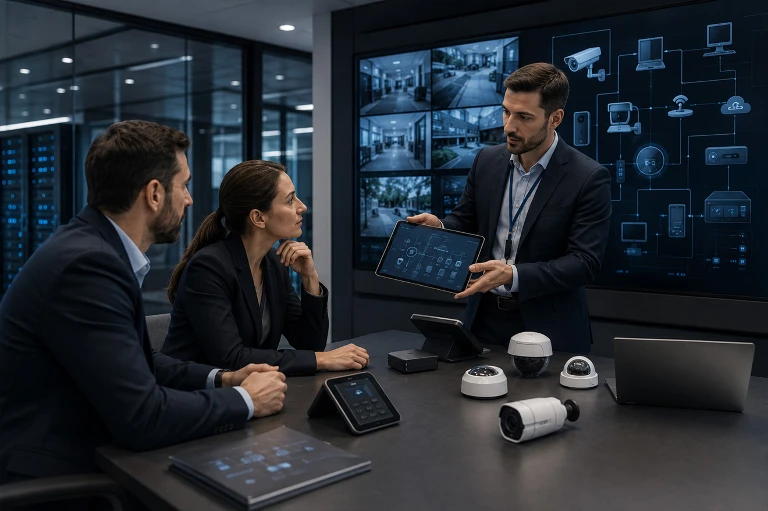
Instead of solutions that address short term needs but create lock in within a few years, a growth and life cycle plan is developed.
The roadmap brings existing investments, priority risks, the integration layer, and budget cycles together within a unified timeline.
- Technology Planning and Transformation
Technology Strategy and Investment Roadmap
Target Architecture and Development Scenario
Target architecture and a three to five year development scenario.
Open Standards and Data Portability
Analysis of open standards, APIs/SDKs, data portability, and vendor dependency.
Capacity and Scalability Plan
Capacity, redundancy, licensing, and scalability planning.
Life Cycle and Supply Continuity
Product end of life, warranty, service, and supply continuity.
Phased Transformation Plan
Quick wins, pilot implementation, rollout, and modernization phases.
Artificial Intelligence and Video Analytics Consulting
AI analytics should not be selected solely based on the accuracy rate demonstrated in a product demo. The business problem, camera angle, data quality, cost of false alarms, human verification, and integration workflow should be evaluated together.
- People counting, perimeter intrusion, PPE, smoke/fire, and behavioral scenarios
- Definition of success criteria, test datasets, and acceptance thresholds
- Comparison of edge, server based, and cloud analytics architectures
- Privacy, retention, access control, and human oversight requirements
- Pilot testing, false alarm analysis, and rollout decisions
Decision support note: Artificial intelligence is not an authority that automatically makes the correct security decision; it is a tool that classifies events and helps operators prioritize them. Critical scenarios should be managed through human verification and clearly defined procedures.
Cybersecurity and Data Governance Consulting
IP based cameras, access control, IoT, and cloud components form part of an organization s cyber risk surface. The consulting engagement addresses governance, asset visibility, protection, detection, incident response, and recovery capabilities together.
- Inventory of assets, accounts, network flows, remote access, and data
- Role based access, authentication, and the principle of least privilege
- Network segmentation, encryption, certificates, and secure configuration
- Device firmware, patching, vulnerability, and vendor advisory tracking
- Log monitoring, backups, incident response, and recovery planning
The control set is developed according to the organization's risk profile. Frameworks such as NIST CSF 2.0 may be used as a reference for organizing objectives from governance through recovery; however, the applicable technical and legal requirements are determined on a project-specific basis.