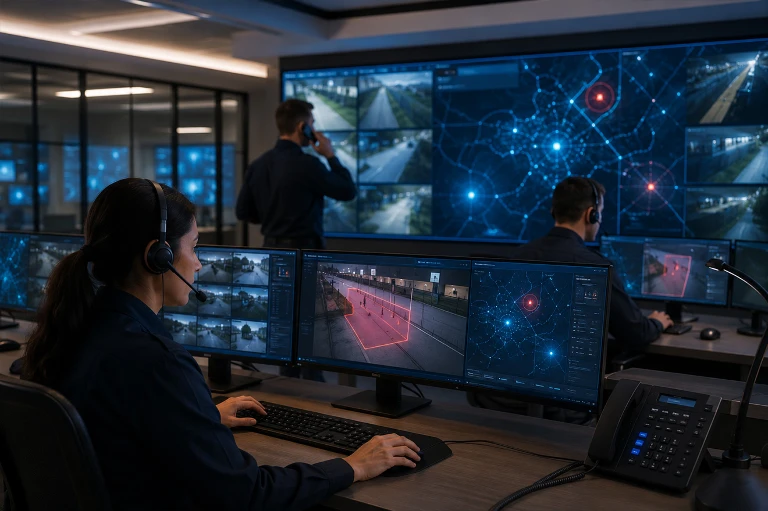
Video Management Software (VMS)
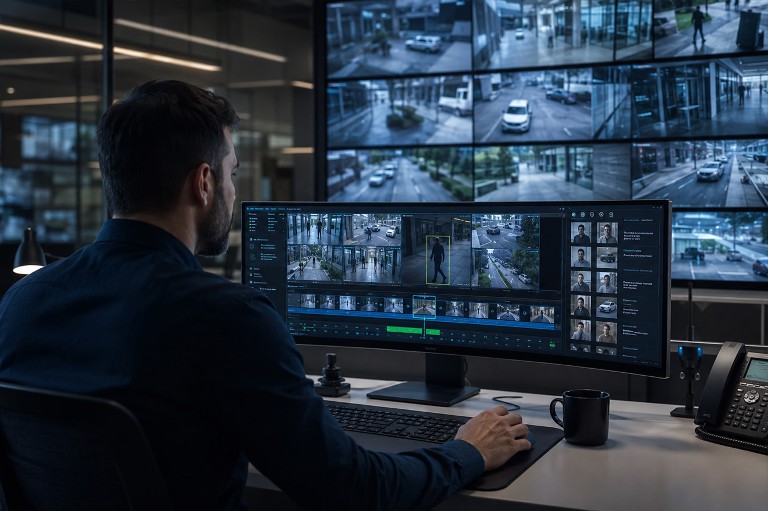
Manage cameras, alarms, and security data from a single center.
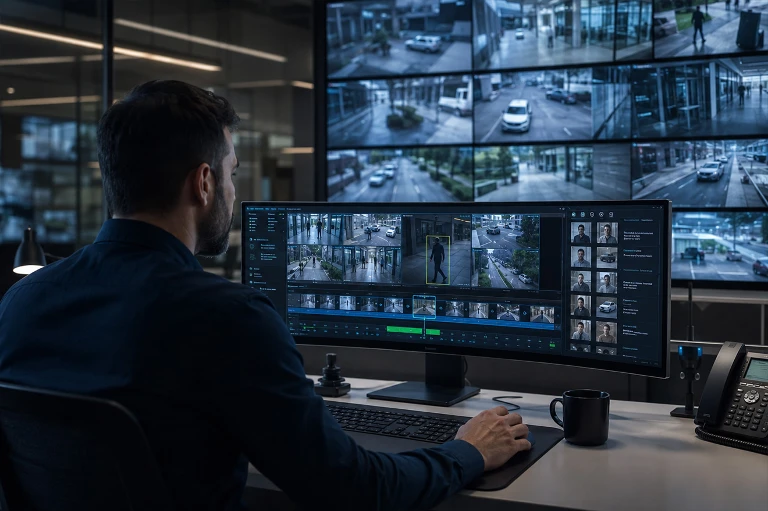
We combine camera infrastructures from different brands and locations within a single operational environment featuring live monitoring, recording, alarm management, intelligent search, and reporting capabilities.
iTech Project designs scalable video management software (VMS) architectures by evaluating camera count, location structure, retention period, bandwidth, user roles, integration needs, and cybersecurity requirements together. Solutions can be deployed in new projects or integrated with compatible existing CCTV infrastructures.
The right architecture: VMS selection is not based solely on camera count. Image quality, storage, redundancy, network capacity, authorization, business continuity, and total cost of ownership must be considered together.
What Is Video Management Software (VMS)?
VMS is a software platform that centrally manages live and recorded camera footage, alarms, user permissions, system health, evidence export, and third-party integrations. While an NVR primarily focuses on recording, enterprise VMS solutions can provide distributed architecture, multi-location management, advanced authorization, analytics, and integration capabilities.
- Centralized Video Management Approach
Why iTech Project?
Rather than imposing a single brand or deployment model, iTech Project evaluates the existing camera infrastructure, operational objectives, information technology requirements, and future growth plans together.
Our objective is to create a video management system architecture that security teams can use effectively, that is compatible with the IT infrastructure, scalable, and manageable throughout the entire investment life cycle.
Vendor-Independent Evaluation
We determine the appropriate VMS structure by objectively evaluating products, system architectures, and licensing models according to project requirements.
Infrastructure Modernization
We modernize the infrastructure in a controlled and sustainable manner while preserving existing camera, recording, and network investments wherever possible.
Multi-System Integration
We integrate the VMS infrastructure with electronic security, AI powered analytics, and enterprise business systems in a controlled manner.
End-to-End Project Management
We manage the entire process, from site survey and needs analysis to architectural design, implementation, integration, testing, and acceptance.
Manage your security operations from a single center. Contact iTech Project to evaluate your existing camera infrastructure, design a new VMS, or integrate multiple locations.

Open Integration and Unified Security
Through supported APIs, SDKs, and device profiles, a VMS can bring security and operational systems together within a shared data flow. The integration scope is determined according to the compatibility and licensing structure of the selected products.
- Access control, visitor management, and intercom
- Fire detection, perimeter security, and intrusion detection systems
- License plate recognition, video analytics, and artificial intelligence applications
- BMS/SCADA, POS/ERP, and retail operations data
- Centralized maps, alarms, and standard response procedures
Cybersecurity and Data Governance
The video security infrastructure should be designed as part of the organizations overall cybersecurity and personal data management approach. Depending on product support and project policy, the following controls are applied:
- Role-based access based on the principle of least privilege
- Multi-factor authentication on supported platforms
- Network segmentation, certificate, and encryption policies
- Management of software, firmware, and security updates
- Audit logs, retention periods, backups, and authorized export
Deployment Options
Deployment Models: On Premise, Hybrid, and Cloud VMS
Video management systems can be configured as on premise, hybrid, or cloud-based according to the organizations existing infrastructure, security policies, location structure, data retention requirements, and growth objectives.
On-Premise VMS
Recording, storage, and management components operate on the organization’s own physical or virtual server infrastructure. This model is preferred for projects where direct control over data, low latency on the local network, and organization-specific integration requirements are priorities. Server capacity, storage space, redundancy, maintenance, and update responsibilities are planned according to the operating model.
Hybrid VMS
It combines local recording infrastructure with cloud based management, backup, reporting, or secure remote access capabilities within the same architecture. It provides a flexible and scalable transition model for organizations that want to preserve existing investments while modernizing gradually or managing the needs of different locations under a single structure.
Cloud VMS / VSaaS
Solutions in which cameras connect to a cloud platform directly or through a secure gateway can provide advantages such as subscription-based operation, centralized management, easy scalability, and remote access. Bandwidth, data residency, video retention policy, cybersecurity, regulatory compliance, and total usage cost should be evaluated in detail before the project.
When determining the most appropriate VMS deployment model, not only the initial investment cost but also system performance, data security, operational responsibilities, connection continuity, and future capacity needs are considered together. This creates a sustainable video management infrastructure aligned with the organization’s technical and operational expectations.
Application Areas
Retail stores and multi-branch businesses, factories, warehouses and logistics centers, offices, campuses, hotels, hospitals and educational facilities, banks, data centers and critical infrastructures, airports, transportation facilities and large area applications, smart city, facility security and operational analytics projects.
Frequently Asked Questions
An NVR primarily enables the recording and monitoring of network cameras. An enterprise VMS, on the other hand, can provide a more comprehensive management layer with multi-server and multi-site management, detailed user authorization, alarm workflows, video analytics, reporting, and third-party system integrations.
A significant portion of the existing infrastructure can be retained, depending on the camera model, supported protocol or driver, device firmware, and required functions. Full compatibility should be verified using up-to-date device support lists and tests conducted under actual field conditions.
No. A VMS infrastructure can be deployed on-premises, in a hybrid environment, or entirely in the cloud. The appropriate architecture should be selected by evaluating data security policies, network capacity, remote access requirements, existing IT resources, scalability plans, and the total cost structure.
When calculating storage capacity, the number of cameras, resolution, frame rate, codec type, level of motion within the scene, continuous or event-based recording method, retention period, and redundancy level should be evaluated together. The final capacity should be determined by adding an appropriate safety margin based on pilot measurements and manufacturer calculations.
Not every AI feature may work with every camera model. Analytics can be performed either on the camera or on a central server. Compatible image quality, metadata support, the required licenses, and sufficient processing capacity must be provided. The expected accuracy should be tested under real-world field conditions.